
Professional vibro-compaction services are considered one of the most important and effective engineering methods for improving soil stability and enhancing the strength of foundations in various construction projects. Its use has significantly and noticeably increased recently, leading to the common question: Why choose professional vibro-compaction services? In this article, we will answer the question and discuss the main advantages and common uses of vibro-compaction.
Common uses of vibro-compaction

Before answering the question, Why choose professional vibro-compaction services?, one must know what is vibro compaction. It is a modern geotechnical technique that is widely used to increase the density of non-cohesive soils and enhance their strength and bearing capacity before major construction operations. It can be used for several purposes and projects which are:
- Enhancing the soil’s capacity to bear vertical loads to reduce the size and depth of foundations required for the building.
- It is particularly preferred for constructing foundations for large projects, roads, railways, bridges, and dams.
- It is widely and highly effectively used for compacting and densifying sand when executing or building projects on loose sandy soil types.
- Increasing the soil stiffness modulus and enhancing its relative density.
- Reducing the risk and likelihood of liquefaction for saturated sandy soils and helping to reduce settlement due to moisture changes to minimize erosion of buildings and their foundations and increase their lifespan.
- Preventing or reducing the occurrence of differential settlement, vibrations, and cracks in the soil to ensure the safety and stability of the structure.
Advantages of vibro-compaction
The answer to the question, Why choose professional vibro-compaction services?, lies in its key advantages. Many individuals wonder about its widespread use, especially after the increased application of vibro-compaction in numerous projects. This is because there are several benefits obtained when using this type of compaction which are:
- It is relatively environmentally friendly as vibro-compaction is used without adding any chemical additives that have harmful effects on the environment or soil.
- It is also relatively quiet compared to some other driving methods and easy to apply. Therefore, it is preferred for use in crowded residential areas to mitigate noise levels and disturbance to residents during large projects.
- In the long run, it contributes to reducing soil settlement problems and the overall project cost because it decreases the likelihood of cracks, fissures, and erosion in buildings and their foundations, leading to an increased lifespan and reduced future maintenance and repair costs.
- It can be effectively used in various types of granular and sandy soils and different types of projects and foundations which makes it suitable for many engineering projects.
- It achieves soil displacement and densification in place without the need to remove large quantities of soil, leading to reduced costs of spoil transport and treatment.
- Maintaining the original site elevation approximately due to the lack of need to remove large amounts of soil and replace it.
Disadvantages of vibro-compaction
Despite the advantages, there are some disadvantages or limitations that arise or must be considered when using the vibro compaction process, which are:
- It cannot be used effectively or safely with organic or highly contaminated soils.
- It is preferably used primarily in non-cohesive or granular soils free of clay.
- It cannot be used effectively with soil types that contain a high percentage of silt or clay more than 15-20%.
- The necessity of conducting a thorough site investigation and testing, taking multiple soil samples and analyzing them before starting the compaction or vibro-compaction process.
When is vibro-compaction preferred?
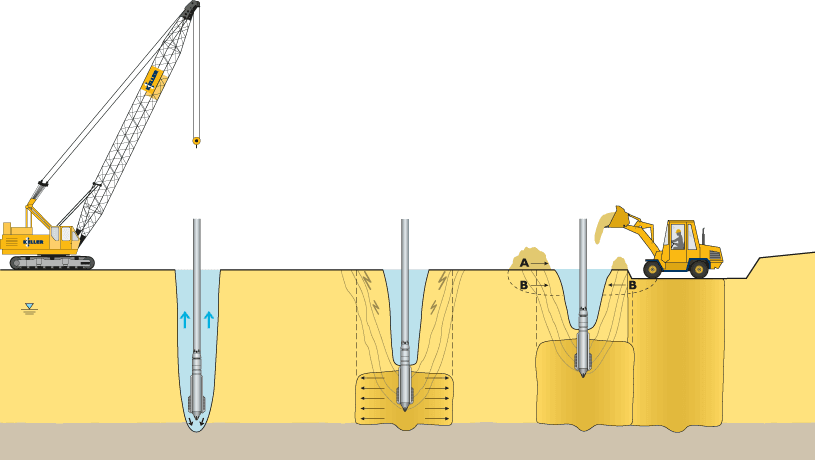
The vibro-compaction or Stone Columns technique is widely and preferably used in cases of loose sandy and granular soils because this type of soil contains numerous voids and pores. vibro-compaction significantly helps in reducing the size of these pores which leads to enhanced soil cohesion, increased strength and capacity to bear large loads, especially before constructing large projects with high loads.
This is achieved by using special vibratory equipment such as a Vibrator Probe or some vibratory plates and rollers in the case of surface compaction. This contributes to compacting and densifying the soil with strong vibrations to enhance cohesion and rearrange the grains. Therefore, it is considered one of the most effective and economical methods used in improving the properties of sandy soil before construction.
Mechanism of vibro-compaction
After understanding Why Choose Professional Vibro-Compaction Services, the mechanism must be understood. Deep vibro-compaction relies on a probe or vibrating arms connected to a crane that lowers them into the ground. The strong vibration helps penetrate the soil, temporarily loosening it while expelling excess water within it and reducing the distances and voids between soil particles. This makes it denser and more stable.
In some techniques like stone columns, backfill materials such as gravel or crushed stone are added to the formed hole to compensate for any volume reduction and to form a dense stone column. The required depth for the vibrating arms and treatment depends on the soil nature, project size and load type. The treatment depth may range from 15 feet to 120 feet or more. There is a control screen on the vibro-compaction equipment that records and measures the penetration rate, withdrawal rate, consumed amperage and monitors the correct operation of the vibrating arms to ensure that no deviations in the process and helping to strengthen and improve the soil properties beneath the structure.
Suitable soil types for vibro-compaction
As mentioned, the best types of soil suitable for vibro-compaction are clean sandy soil or soil with low silt content, coarse-grained granular soil such as gravel and generally non-cohesive soils.
However, it is not effectively or economically suitable for soils containing a high amount of silt and clay. In such cases, it is preferable to use other soil improvement techniques suitable for fine-grained soils.
Comparison between vibro-compaction and traditional soil improvement methods

In many applications, vibro-compaction is considered one of the best and fastest methods that can be used for soil improvement in cases of sandy and granular soils because it significantly contributes to enhancing their density at depth without the need for costly excavation and replacement operations at great depths. Vibration greatly helps in improving densification and compaction processes which make them stronger and more effective because it relies on the combined effect of pressure and vibration to rearrange the grains.
Other traditional methods such as replacement or grouting may rely on different mechanisms like removing weak soil or adding binding materials. Therefore, some might be more suitable for cohesive soils like clay soil. There are also some types of traditional equipment such as other surface compactors that can be used for surface compaction in small projects or confined spaces and trenches, like jumping jack compactors or plate compactors.
Precautions to be taken during vibro-compaction
After knowing why to choose professional vibro-compaction services, there are some important precautions that must be followed before and during the vibro-compaction process which are:
- Accurately identifying and examining the soil type and its properties correctly to determine the geological and engineering characteristics and ensure its suitability for the vibro-compaction process.
- Selecting the necessary and appropriate tools, equipment, and technique for the project to perform the vibro-compaction process effectively and efficiently.
- Engaging a specialized company and a team of skilled technicians and engineers to handle the compaction and vibro-compaction techniques and supervise the execution.
Why is WHC the best for providing vibro-compaction service?
WHC company is considered one of the best specialized and leading companies that can be relied upon for professional and high-quality vibro-compaction services. The company provides a range of the best and latest equipment used for vibro-compaction services. It also employs a group of specialized and experienced engineers and technicians to operate these devices and perform the vibro-compaction process effectively and accurately. This company has earned the admiration and trust of all clients who have previously dealt with it.
The question: Why choose professional vibro-compaction services? has become common. This is because it has great and proven effectiveness in increasing soil strength and durability which leads to enhancing the strength and stability of structures and foundations and reducing future maintenance costs.
FAQs
What is the most effective method of compacting sand?
What is the specification of vibro compaction?
One of its most important specifications and features is that it performs soil densification and compaction in place without the need to remove it or add large quantities of materials. It is used effectively at various depths, even very great depths.
Why is compaction important in civil engineering?
Soil compaction and the improvement of its properties are very important in civil engineering because it significantly helps in reducing voids and distances between soil particles leading to increased density and capacity to safely bear the loads of large projects, to increase strength, resistance to settlement and durability.