
The establishment of modern road infrastructure greatly depends on the stable conditions of the subgrade. Bad or expansive soils can lead to early breakdown, surface deformation, and high maintenance costs. Accordingly, the inclusion of soil stabilization methods in the construction of roads has become an integral part of civil engineering.
Through the modification or improvement of the physical and chemical features of soil, the project manager can produce a more durable and less variable base course of roads.
This piece dives deep into the soil stabilization methods that are important, the types of soil stabilization in road construction, and finally, the role of soil stabilization in road construction projects.
What Is Soil Stabilization?
Soil stabilization is the process of changing the soil properties to make them more suitable for the purpose. One of the ways this is achieved is through the means of mechanical, chemical, and physical changes. In the scope of soil stabilization in road construction, stabilization is the guarantee that the pavement system can bear the load of the vehicles continuously without any deformation or subsidence.
Recognition of suitable soil stabilization methods and materials is a fundamental requirement in the formulation of durable road structures, mostly in areas where the soil conditions are poor.
Importance of Soil Stabilization in Road Construction
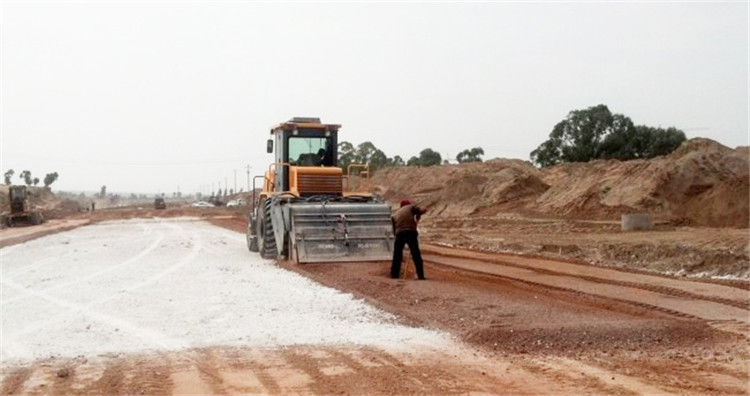
The significance of soil stabilization in road construction is huge. Low-quality soil is the primary factor that leads to the damage of roads.
By improving the soil’s performance, engineers can achieve:
- It is a requirement to elevate the pavement’s carrying capacity.
- To keep the road surface from getting cracked and rutted.
- Less construction, as well as maintenance, will lead to cost savings.
- Make the lifetime of the pavement longer.
This serves to underline the point of the selection of soil stabilization methods and materials in the preliminary phase of project planning as being fundamentally important.
Soil Stabilization Methods
There are quite a few familiar soil stabilization methods, and each one is chosen because of the peculiarities of the soil and environmental conditions.
The main categories are:
- Mechanical stabilization: Soils are either mixed or compacted to gain higher density and less porosity
- Chemical stabilization: The addition of binders such as cement, lime, fly ash, or polymers to the soil to increase the cohesive force
- Bituminous stabilization: Soil waterproofing and strengthening with bitumen or asphalt
- Thermal stabilization: Using heat to alter soil properties (not common nowadays)
These are the methods that significantly contribute to soil stabilization in road construction, especially in areas with expansive or soft soils.
Types of Soil Stabilization in Road Construction

Several Road Construction soil stabilization methods exist, and most of the time, which one is used depends on some factors like the subgrade condition and the design specifications.
- Lime Stabilization: For clayey soils with high plasticity
- Cement Stabilization: For high-strength and load-bearing subgrades
- Fly Ash Stabilization: An economical method that uses industrial byproducts
- Bitumen Stabilization: Waterproofs the soil and gives flexibility
- Polymer-Based Stabilization: The method can be used for fast-setting, eco-sensitive applications
Each way the soil gets stabilized, and the materials used are specifically for a particular purpose, and therefore must be the choice considering the project’s economic and technical needs.
Cement Stabilization: A Preferred Technique
Out of all the techniques practised for soil stabilization, cement stabilization stands as the most favorite one in the field of road construction. It creates a solid and resilient structure by binding the soil particles together with the formation of cementitious bonds.
Merits:
- Great compressive strength
- Long lasting
- Moisture and ice resistance
The choice of this method places stress on the significance of soil stabilization in road construction projects that intend to take up heavy traffic loading and have a long service life.
Lime Stabilization for Clay Soils
That is, lime is typically the best alternative when it comes to managing the expansive clay soil because it reacts with the clay mineral particles, causing a decrease in the plasticity and an increase in the strength of the mixture to a reasonable level
Benefits of this technique:
- Lowers the workability of the soil
- Eliminates the swelling and shrinking behavior
- Improves the long-term durability of the soil
This method finds a better application in the stabilization of soil in a road construction project on rural or low-traffic roads, especially in regions with high clay content.
Mechanical Soil Stabilization Techniques

Mechanical stabilization refers to the process of squeezing the soil or adding other materials to the soil, such as aggregates, such as gravel or sand. It is the most environmentally and pocket-friendly method.
Applications:
- Preparation of the original subgrade
- Stabilization of the weak soils without using chemicals
- TMP roads and the roads used for construction haulage
Soil stabilization in road construction is thus still one of the most basic types of soil stabilization, although mechanical stabilization does not involve chemicals and is often done together with chemical methods
Advantages of Soil Stabilization in Road Construction
The advantages of soil stabilization in road construction are many:
- Amazing bearing capacity: Makes the road more durable under heavy loads
- Thinner pavement: Subgrades stabilized require less structural material
- Greater durability; the roads with better pavement have a longer service life
- Lower life-cycle cost; the maintenance and repair frequency are decreasing
These benefits are instrumental in the increasing request for proper soil stabilization in road construction, particularly for the development of long-term infrastructure.
How to Select the Proper Soil Stabilization Methods and Materials

Choosing the right soil stabilization methods and materials is a function of the following major factors:
- Soil type (clay, silt, sand, etc.)
- Environmental conditions (wet, dry, freeze-thaw)
- Traffic load expectations
- Project timeline and budget
- Availability of local materials
A comprehensive geotechnical investigation will ascertain the best methodology. In most cases, a combination of methods is the most effective solution for the stabilization of soil in road construction projects.
Sustainability and Innovation in Soil Stabilization
Modern construction emphasizes eco-friendly approaches. Innovative soil stabilization methods and materials are being developed to reduce environmental impact:
- Enzyme-based stabilizers
- Recycled materials like fly ash and slag
- Geosynthetics for reinforcement
These materials offer long-term performance while aligning with sustainable goals. The integration of green technologies into soil stabilization in road construction is paving the way for smarter, more resilient roads.
Summary
Soil stabilization is a strategically planned investment that is not only a technical problem but also aimed at durability, safety, and many other aspects. The soil stabilization methods are numerous, and those that are most difficult to handle can be handled by the engineers.
Being aware of the different types of soil stabilization in road construction, the importance and the qualities of the most efficient soil stabilization methods and materials are vital for the long-term success of the infrastructure.
Frequently Asked Questions (FAQs)
What is the most common method of soil stabilization in road construction?
One of the most commonly used soil stabilization methods in road construction is cement stabilization. It is not only convenient but quite easy to use in situations where a high volume of vehicles is moving through the roads, since the method itself is sufficiently strong, and then it becomes more durable when uniquely used in higher traffic areas.
Can multiple stabilization methods be used together?
Yes. They are able, through the combination techniques of mechanical and chemical stabilization, to come up with high standards of performance in road construction soil stabilization.
How does soil stabilization reduce costs?
Road construction projects realize multiple savings as the initially calculated multiple-layer pavement is no longer a requirement, and they don't come to be if soil stabilization is constructed by the earth material method. What the industries will have opted for to run on the road instead of a pavement will be very expensive, apart from the initial high cost of the road construction.
Is soil stabilization environmentally friendly?
a: It involves the materials in question. Today's soil stabilization methods and materials, deemed the modern ones, can be implicitly referred to as environmentally responsible using reprocessed or green binders.
What methods do engineers use to determine soil stabilization efficiency?
Engineers rely on tests such as the California Bearing Ratio (CBR), the Unconfined Compressive Strength (UCS), and moisture susceptibility tests to assess the performance of the stabilized soil.