
For the creation of a secure and durable structure, the first and foremost thing is the strength and stability of the land it is located on. Finding the land on which the structure rests to be of bad quality can very much result in a failed substructure, extreme settling, and the destruction of the building.
This is why the Soil Improvement and Ground Modification Methods are an integral part of the present-day geotechnical engineering.
Deciding on the best ground improvement method for the construction of high-rise buildings, roads, embankments, ports, etc., is a critical thing that one needs to think through. In this guide, we take a look at different soil improvement methods, offering detailed explanations of their pros and cons, as well as real-world applications.
What is Soil Improvement?
The activities that we have just mentioned define soil improvement and ground modification methods, which are the way the soil’s physical properties are improved to be in accordance with the particular needs of a certain construction project.
The aim is to elevate the carrying capacity, the strength beyond the ground-to-roof depth, that is, both, to decrease the amount of the building’s settling and to enhance the drainage, thereby reducing the risk of liquefaction.
To achieve the improvements mentioned, various soil improvement techniques are used, including mechanical compaction, chemical stabilization, or physical soil properties alteration.
Why Ground Modification Is Necessary

In towns, which are in different parts of the world, especially the ones that are in development zones or near the sea, the original soil is likely to be unsuitable for construction for the following reasons:
- Low bearing capacity
- High compressibility
- High water content
- Loose or organic soil layers
Besides, the use of suitable ground modification techniques for such soil types will also prevent the potential risk of natural calamities. Furthermore, the failure could be catastrophic, resulting in minor cracks or total structural collapse.
This is the role of soil improvement and ground modification methods, which is to enable proper and economic construction when and where it is needed.
Types of Soil Improvement Techniques
Here are the most widely used types of soil improvement:
| Technique | Purpose | Typical Use Cases |
| Mechanical Compaction | Increases density and strength | Roads, embankments |
| Preloading & Surcharging | Reduces future settlement | Reclaimed lands, highways |
| Chemical Stabilization | Enhances cohesion and strength | Clayey soils, pavements |
| Geosynthetics Reinforcement | Provides tensile strength and separation | Retaining walls, slopes |
| Drainage Improvement | Enhances consolidation | Soft clay areas |
| Grouting | Fills voids, strengthens soils | Underpinning, tunneling |
| Deep Soil Mixing | Combines soil with binders | Foundations, liquefaction control |
| Vibroflotation | Rearranges granular soils to increase density | Port structures, sandy soils |
Each of these soil improvement and ground modification methods must be chosen based on soil type, loading conditions, and project timeline.
Mechanical Soil Compaction

Mechanical compaction, one of the oldest and cheapest soil modification techniques, is also the first job. This means that the volume of soil can be reduced by using equipment such as rollers, vibrators, or rammers.
Benefits:
- Simple and immediate
- No chemical hazards
- Raises the load-bearing capacity
Limitations:
- Does not work for water-saturated clays
- For the deep layers, more waves may be needed
This is especially useful for shallow foundations, road bases, and embankments, and remains one of the most widely used soil improvement and ground modification methods globally.
Preloading and Surcharging Ground Improvement
Surcharging ground improvement is a passive method where an extra load is temporarily placed on the ground to accelerate soil consolidation before actual construction begins.
How It Works:
The surcharge compresses the soil, expelling pore water and reducing settlement after construction.
Applications:
- Reclaimed land
- Soft clay improvement
- Airport runways
To enhance the efficiency of this ground improvement method, vertical drains are often used to speed up water removal. It’s one of the most time-tested soil improvement and ground modification methods for deep compressible soils.
Chemical Soil Stabilization
Chemical methods modify the internal structure of the soil by adding binders such as lime, cement, fly ash, or polymers.
Advantages:
- Improves strength and durability
- Effective for clayey soils
- Resistant to weathering
Disadvantages:
- Environmental considerations
- Requires skilled handling
This soil improvement method is commonly used for subgrade stabilization in roads and pavements and can be integrated with other soil improvement and ground modification methods for even better results.
Vibroflotation Method of Ground Improvement
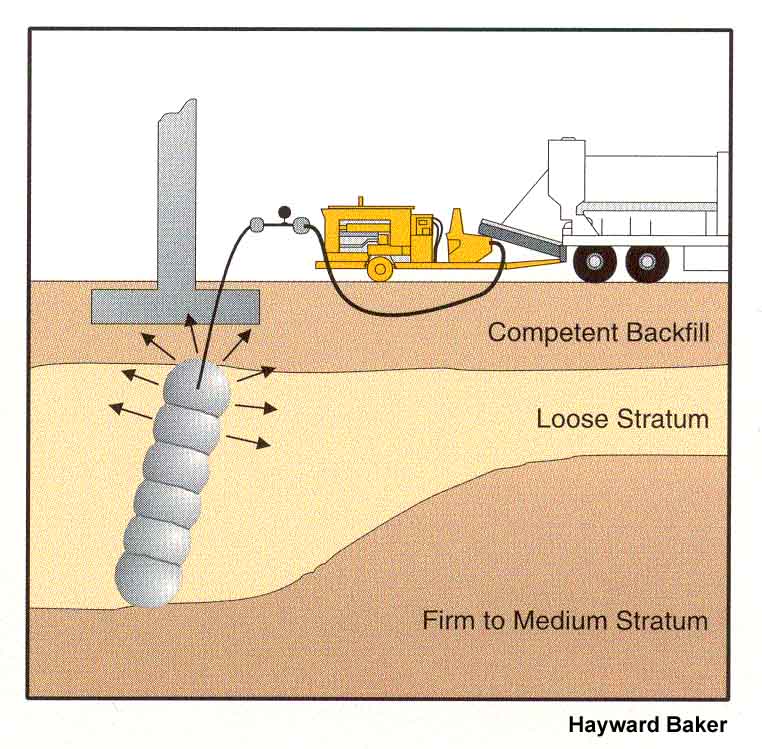
The vibroflotation method of ground improvement is used to densify loose granular soils using a vibrating probe. The probe is inserted into the ground, and water is used to assist penetration. As it vibrates, soil particles rearrange and compact.
Ideal Conditions:
- Sandy or gravelly soils
- Deep foundations
- Marine structures
This ground modification technique is effective up to 40 meters deep and is widely used in port construction and offshore platforms. As one of the more specialized soil improvement and ground modification methods, it is ideal for granular soil profiles.
Deep Soil Mixing
In deep soil mixing, binders are mixed into the soil using rotating augers. The resulting soil-cement columns enhance the ground’s shear strength and reduce permeability.
Applications:
- Liquefaction mitigation
- Embankment support
- Foundation soil reinforcement
This soil improvement technique is ideal for stabilizing soft, high-water-content soils, especially in urban areas where excavation is limited. It’s frequently combined with other soil improvement and ground modification methods for maximum effect.
Ground Modification Techniques Using Geosynthetics
Geosynthetics are a group of products that include geotextiles, geogrids, and geomembranes.
They contribute to the stabilization of the soil in the following ways:
- Providing tensile strength
- Separating different soil layers
- Improving drainage
This strategy for changing the ground is widely used in the following areas:
- Road and railway embankments
- Retaining wall systems
- Landfill liners
At the same time, geosynthetics are environmentally friendly products that can easily be combined with other soil improvement and ground modification methods to form hybrid systems.
Such a technique of soil improvement is very efficient in the consolidation of mushy and high-water-content soils, especially in places where excavation is restricted due to the urban setting. As a rule, it is paired with other soil improvement and ground modification techniques to increase its efficiency.
Ground Modification Techniques Using Geosynthetics

Geosynthetics are materials such as geotextiles, geogrids, and geomembranes. They are instrumental in soil stabilization by:
- Providing tensile strength
- Separating different soil layers
- Improving drainage
This ground modification technique is a widely recognized one in the sectors of:
- Road and rail embankments
- Retaining wall systems
- Landfill liners
Geosynthetics are sustainable and can easily be incorporated into hybrid soil improvement and ground modification systems.
This soil improvement method is perfect for consolidating soft, high-water-content soils, mainly in the city, where depletion is limited, and it is often combined with other soil improvement and ground modification techniques to obtain the maximum effect.
Ground Modification Techniques Using Geosynthetics
Geosynthetics include materials like geotextiles, geogrids
- Vertical drains (VDs)
- Wicking sand
- Well points and vacuum consolidation
These systems help eliminate excess pore water and hence speed up the consolidation process, and also increase effective stress in the soil. Coupled with surcharging ground improvement, drainage methods are considered the most efficient soil improvement and ground modification methods in major projects.
Conclusion
Modern construction needs solid insights into soil behavior along with the means of its improvement. The way from old conventional techniques of surcharging ground improvement to the ones comparable to the latest technology, like various types of deep soil mixing and the vibroflotation method in ground improvement, indicates that available methods meet the scope of many geotechnical challenges.
Today, every type of land can benefit from an engineering solution, some of which can even lower construction costs and reduce project risk or prolong the life of their particular project. If it is pure clay, sandy areas, or loam, and in every case, investing in the right soil improvement and ground modification methods should be the non-negotiable term of successful construction.
If you are going to initiate a project and require the experts’ support, think of consulting the professionals who work with soil improvement and ground modification methods to study, design, and implement the solution that matches your particular situation.
Frequently Asked Questions (FAQs)
How to choose the right soil treatment method?
The choice of method mainly depends on the type of soil, its water content, the strength required, the depth of treatment, and also on the available budget. A geotechnical investigation would be essential to specify the most suitable soil improvement and ground modification methods for your site.
What is the difference between soil improvement and ground modification?
Although they both concentrate on increasing soil efficiency, soil improvement generally includes the modification of the soil in its original place, while ground modification is more inclusive as it can even comprise soil layer replacement, reinforcement, or mixing activities. Collectively, all that falls into the category of soil improvement and ground modification methods.
Is the vibroflotation method safe for nearby structures?
Yes, but it has to be checked with a vibration monitor. The vibration generated by the method is monitored and is normally not used if it could affect the stability of the buildings around.
How long does surcharging take?
The period for surcharging ground improvement highly depends on the soil type and thickness at the location, so it can be as short as a few weeks or as long as several months.
Can multiple techniques be combined?
No doubt. One good example is to use chemical stabilization with vertical drainage as well as geosynthetics with mechanical compaction. This kind of method is known as a hybrid soil improvement and ground modification method.