
Soil is considered one of the important elements that plays a vital role in our lives. With continuous technological progress in civil engineering and construction, the importance of using the Rapid Impact Replacement method to improve weak, cohesive, or mixed soils has increased.
This technique is used to improve and stabilize the ground through repeated high-energy impact processes that lead to the creation of columns of strong granular material within the ground. This strong material is driven downwards, displacing the surrounding weak soil and forming reinforced columns that stabilize the weak ground and increase its ability to bear various structural loads.
In this article, we will discuss what Rapid Impact Replacement for ground stabilization is and the benefits of its use in engineering projects.
What is Rapid Impact Replacement for ground stabilization?
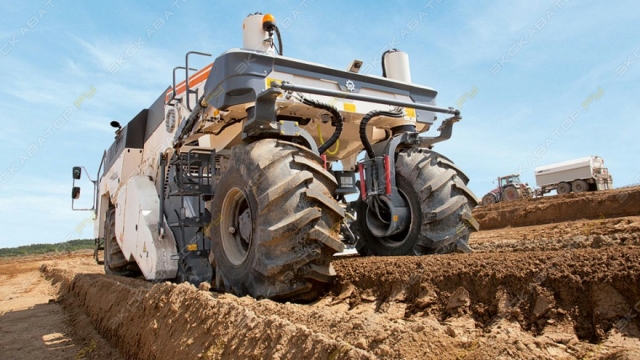
Rapid Impact Replacement for ground stabilization is a geotechnical technique used to improve the properties of weak, cohesive, organic, or heterogeneous fill soils by creating columns of strong granular material using a special hydraulic hammer.
The hammer strikes a special foot placed on the ground surface or directly drives the added granular material repeatedly and with relatively high energy. This drives the strong material into the weak soil, displacing it laterally and forming dense, stiff reinforced columns.
The depth of influence of this technique can typically reach about 5 meters or more, depending on site conditions and hammer energy. Stone or aggregate columns are created in the ground by progressively adding the granular material and compacting it downwards with the hammer blows.This results in a composite ground system that is more efficient and effective in safely bearing imposed loads and reducing settlement.
Benefits of using Rapid Impact Replacement for Ground Stabilization
There are many diverse benefits to using the Rapid Impact Replacement for Ground Stabilization, among the most prominent of these benefits are:
- It is considered an effective and fast means to create reinforcing columns to improve the properties of weak soil.
- It improves soil properties and significantly and noticeably increases its overall stiffness.
- It increases the overall bearing capacity of the foundation layer.
- It can help mitigate liquefaction risks in saturated sandy soils by providing reinforcement and potential drainage paths.
- It supports nearby foundations or those built upon it.
- It can alter drainage patterns and reduce overall settlement from long-term consolidation of weak soils.
- It increases the ability to construct many industrial and residential projects with greater safety on weak ground.
- It reduces the risks of building instability due to weak soil.
- It reduces potential future maintenance and repair costs for structures.
How does the Rapid Impact Replacement technique work?

The Rapid Impact Replacement technique works by using specialized hydraulic hammers that strike a special foot or a mound of granular material on the ground surface with high energy and repeatedly. This leads to driving the selected granular material into the weak soil. This process displaces the surrounding soft soil laterally and forms dense, stiff columns of the added material. The result is a composite ground mass with improved overall stiffness and bearing capacity.
Difference between Dynamic Compaction (DC) and Rapid Impact Replacement (RIR)
The fundamental difference between Dynamic Compaction and Rapid Impact Replacement lies in the application mechanism and their effect on the soil:
Dynamic Compaction (DC)
Dynamic compaction of soil is a mechanical process in which very heavy weights are dropped from significant heights onto the soil surface repeatedly. This increases soil density and reduces its porosity over a wide area, thus increasing its bearing capacity; it is considered an effective method for improving soil over large areas.
Rapid Impact Replacement (RIR)
It is one of the prominent methods used to ensure the safety of structures, such as buildings, industrial facilities and bridges built on weak ground. It works by creating localized columns of dense granular material within the weak soil.
Its impact can reach a depth ranging from 3 to 7 meters or more, aiming to improve the properties of the composite soil mass and significantly increase its stiffness in specific areas. This process creates engineered stone columns designed to increase bearing capacity, enhance stability and reduce settlement of structures built on weak soil.
Equipment used in Rapid Impact Replacement
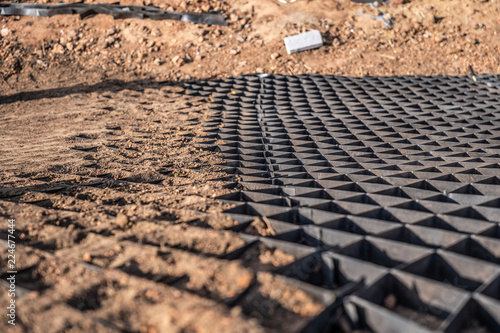
There is much equipment that is used in the Rapid Impact Replacement for Ground Stabilization. Among the most prominent of this dynamic compaction equipment are:
- Powerful Hydraulic Excavator: These powerful excavators are used as a base to carry and guide the hydraulic hammer and its attachments. They operate with significant power, such as the 946 Litronic model.
- Specialized Hydraulic Hammer: This is the main tool that performs the repeated striking process to achieve the desired driving of the granular material. Its weight and energy vary according to project requirements and the required treatment depth.
- Compaction Foot/Plate: A thick steel plate attached below the hammer to efficiently transfer impact energy to the granular material or ground surface.
- Support Equipment: Such as loaders or dozers to supply and spread the granular material at the impact locations.
Risks of using Rapid Impact Replacement and how to avoid them
Rapid Impact dynamic replacement is one of the methods used to reinforce the soil, improve its performance and obtain the maximum benefit from it in bearing loads. However, it may be accompanied by some risks such as vibrations that might affect adjacent structures, potential unexpected changes in groundwater levels, or failure to achieve the required column depth or density/stiffness.
These risks can be avoided through careful site investigation, continuous monitoring during execution, selecting appropriate rapid impact compaction equipment and energy to ensure proper column material placement and compaction and applying necessary safety procedures.
FAQs
What is the removal and replacement method for ground treatment?
The removal and replacement method consists of excavating and removing the weak soil present at the site and replacing it with other soil of better quality that is well-compacted to ensure the stability of the structures built upon it. It differs from the Rapid Impact Replacement for Ground Stabilization, which improves the soil in situ by creating reinforcement columns.
What is ground improvement using the CMC technique?
Ground improvement using the Controlled Modulus Columns technique involves creating columns of granular or concrete materials within weak soil using a special tool that causes minimal lateral soil displacement, with the aim of reducing soil settlement and increasing its bearing capacity. It is used especially in soft or loose soil.
What is the rapid impact evaluation method?
Perhaps what is meant by rapid impact evaluation is the assessment of the effectiveness of the Rapid Impact Replacement process itself. This is usually done by conducting field tests such as the Cone Penetration Test or the Standard Penetration Test before and after treatment to compare the overall ground properties or specific column characteristics and the extent of improvement that has occurred and to ensure that the design improvement criteria have been met. The Rapid Impact Replacement for Ground Stabilization has recently become widespread because it is an effective method that improves the overall strength and stiffness of weak