
Drilling piles are a key component of modern construction, particularly in projects requiring deep foundations due to problematic soil conditions or heavy structural loads.
Drilling piles, in contrast to driven piles, are created by drilling a hole into the ground and then filling it with concrete and reinforcement. Hence, there is no need to insert the concrete components by force (excessive vibrations or hydraulic forces).
This content offers a complete discussion of drilling piles, their different types, the construction process, and their performance in civil engineering.
What Are Drilling Piles?

Bored piles or drilled shafts, commonly known as drilling piles, are deep foundation elements made by drilling a hole in the soil and then filling it with concrete. Additionally, the addition of steel reinforcement is done in order to increase the load-bearing capacity.
While the driven piles displace soil, the base material used in the drilling piles comes out, taking the soil with it. (This method avoids the removal of the land used for the pil
The process makes easy work of the piled building holes and is a much-disliked procedure, regarded as an environmentally friendly method due to its low noise and vibrations, making it suitable for implementation in central city areas or those affected by such structures.
Types of Drilling Piles
There are various types of drilling piles depending on the technology and the needs of a project.
- Drilled Shaft Piles: These are piles of large diameter that are constructed in place and are usually made of concrete. They are generally used in the construction of bridges, high-rise buildings, and other deep foundation projects.
- Continuous Flight Auger (CFA) Piles: This involves drilling with a hollow stem auger and injecting concrete during the withdrawal of the auger.
- Micropiles: Piles having small diameters that are used for propping and strengthening of soil.
- Secant and Tangent Piles: These are used for the purpose of making underground walls.
Drilled shaft piles are the best choice for dealing with high axial or lateral loads, since they are a lot larger in diameter and very deep.
The Significance of Drilled Pile Foundations

Drilled pile foundations are used in situations where shallow foundations are not an option. Properties of these foundations distribute the loads to the lower and more stable ground or rocks to ensure the safety and the serviceability of the structure.
These include:
- Skyscrapers
- Bridges and flyovers are examples.
- Offshore construction
- Walls that hold back
- The factories
If we consider construction in regions characterized by a lack of good surface soil, a high water table, and seismicity, it is hence the fact that these foundations are vital.
How Drilling Piles are Constructed
The process of building drilled shaft piles and drilling piles covers a few main points:
Step 1: Site Preparation and Distribution
Cleaning up the land with surveying and drilling the area, and then locating the drilling rig.
Step 2: Drilling
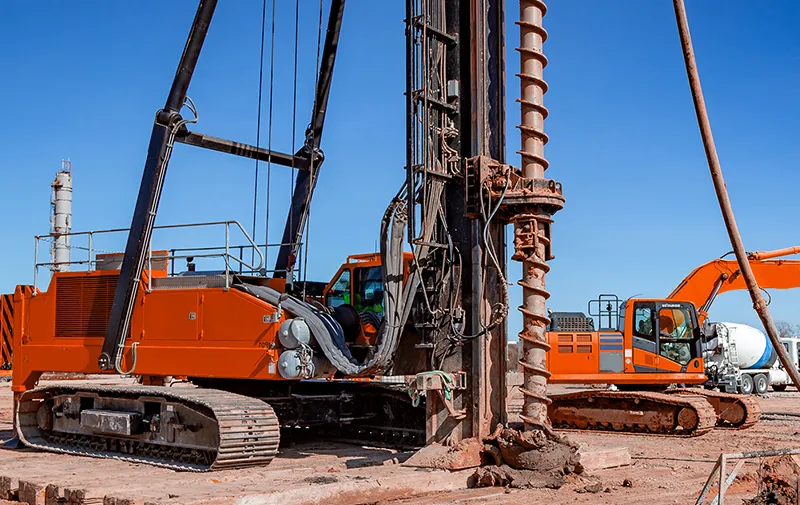
Equipment is used to drill a vertical shaft. The diameter and depth of the drilled hole depend on the soil conditions and the load requirements.
Step 3: Utilization of Drilled Shaft Casing
In case the soil is weak and prone to collapsing, a steel casing of the drilled shaft can be placed into the hole. This temporary or permanent steel casing reinforces the walls of the excavation.
Step 4: Borehole Cleaning
Cleaning of the borehole is the process of removing the materials that are in the hole and the slurry in order to have a good bond between the concrete and the soil.
Step 5: Steel Placing
The borehole is then filled with steel rebar for added strength.
Step 6: Implementing the Concrete
The determined method of casting is through a tremie pipe or free-fall, depending on the groundwater factor.
Drilled Shaft Casing: Purpose and Types
Drilled shaft casing is a space within the shaft that is provided with a lining as a support element. The latter is used as an anti-corrosion layer against the soil.
The purpose of the Casing is to keep the shaft aligned during the drilling operations and protect the workers from falling objects.
Types of Casing:
- Temporary Casing: Only slab-sided and removed after the concrete is poured.
- Permanent Casing: Slab-sided and left in place as part of the foundation, often used in waterlogged conditions.
Casings are generally made from sheet or casing steel, and the thickness and the diameter vary depending on the assignment.
Advantages of Drilling Piles
Drilling of piles has been seen to offer several advantages compared to conventional foundation methods.
These are:
- Less Noise and Vibration: Can be done in urban areas and sensitive zones without any adverse effects.
- Flexibility in Design: The pile may be changed to the needed diameter and depth.
- High Load Capacity: This is dual purpose with no erection or side support; it can work in either the axial or lateral direction.
- Minimal Displacement: It is also called as non-heaving effect. It means movement in the rig is minimal and does not cause any heaving or damage to soil or other structures nearby.
- Adaptability to Different Soils: They provide a stable support system in several soils and rocks without the aid of any additional reinforcement.
The main advantage of construction by this method lies in the fact that it is currently the favored method for the construction of complex infrastructure and projects that involve a high level of risk. Due to these benefits, drilling piles are often the preferred choice in complex infrastructure and high-risk projects.
Limitations and Challenges
One of the negative sides that arise when using drilling piles, despite all their advantages, is the rise of the following limitations:
- Construction Time: The time taken to install drilling machine piles is longer than other equipment that achieves the same results.
- Cost: In most cases, it is more expensive to hire a drilling pile as it demands costly labor and special tools.
- Quality Control: The real problem is that they cannot be properly viewed and controlled after they have been installed. The quality of the installation depends on the experience of the contractors.
- Water Table Problems: Sometimes, the project may require slurry or heavy-duty casing if the drilling pile works under water, which hampers the project.
Effective management of the work through good organization and staff can effectively control and minimize the correct pointing of these issues.
Equipment Used in Drilling Piles

The drilling pile operations call for machines that are very efficient and powerful, as this work is very precise and dangerous if not properly executed:
- Rotary Drilling Rigs: This is meant for drilling the casings. Make sure that the borehole is stable throughout the drilling process.
- Tremie Pipes: It is ideal for the process of concrete casting underwater. Drilling rigs powered by GPS and automation have made the process of piling more accurate and productive, and this is a great advantage
- Casings: Make sure that the borehole is stable throughout the drilling process.
- Tremie Pipes: It is ideal for the process of concrete casting underwater.
Drilled Piles vs. Driven Piles
Here’s a comparison between drilled piles and driven piles:
| Feature | Drilled Piles | Driven Piles |
| Noise and Vibration | Low | High |
| Soil Displacement | Minimal | Significant |
| Load Capacity | High | Moderate to High |
| Construction Speed | Slower | Faster |
| Inspection | Hard to inspect post-installation | Easier to test after driving |
| Groundwater Adaptation | Requires slurry/casing | Less affected |
Drilling piles remain a superior solution in urban zones or where environmental control is critical.
Best Practices in Drilling Pile Installation
The safety and performance of drilling piles are assured by the use of the following best practices:
- Soil Investigation: In-depth geotechnical research that helps guide design.
- Use of Quality Materials: High-strength concrete and anti-corrosion steel are the most commonly used materials.
- Skilled Operators: Certified rig operators and technicians.
- Monitoring and Testing: Use of tools like cross-hole sonic logging (CSL).
- Environmental Considerations: Proper slurry disposal and site management.
A combination of quality control and drilling pile work surely results in an extended period of stable and reliable service in the toughest of conditions.
Conclusion
Drilling piles are not only a cost-effective solution for digging deeper into the ground and reaching the bedrock, but also are a modern method of constructing a deep foundation where traditional shallow methods could not reach. The drill shaft piling technique has been a significant contributor to the advancement of the infrastructure industry through the use of improved equipment, materials, and engineering practices.
Engineers who are familiar with the process, the difficulties, and the best practices are able to design and build energy-effective, safe foundations, especially in the case of challenging environments.
Amidst seismic threats, urban construction constraints, or high structural loads, drilled pile foundations and proper drilled shaft casing methods are reliable sources of strength and stability.
As more and more projects necessitate foundations that are both deeper and more stable, the role of drilling piles will remain crucial to both the layout of our cities and the infrastructure.
FAQs Regarding the Drilling Piles
Can you tell me the difference between the drilled piles and the drilled shafts?
Both terms virtually imply the same thing about deep foundations that are built by the method of drilling and then being filled with reinforced concrete. As the name suggests, the drilled shaft piles are of such type.
Under which conditions is the use of a drilled shaft casing necessary?
According to the rule, when the soil is in a loose, wet, or slumping state, it is mandatory to drill a shaft casing to stabilize the borehole during construction.
How wide is the normal size of a drilled pile?
Drilled pile diameters normally vary from 0.6 meters to even more than 3 meters, depending on the characteristics of the load and the structure that is needed.
What limits are there for the depth at which drilled piles can be inserted?
They are capable of even more than 60 meters deep if we are considering some complex infrastructure projects like the stability of bridges and skyscrapers, especially high-value properties.
Is there a difference in cost between drilled piles and driven piles?
Yes, in most cases, they are more costly as a result of the use of special equipment and longer construction time, but they have far better performance when facing various challenges.
Can drilled piles still be installed in residential construction?
Yes, they can be designed for use in large or multi-story buildings, or in places where only unstable ground is available.
Which type of concrete is the most suitable for drilled pile foundations?
High-strength concrete that is specially designed for deep placement and extends its flowability, often combined with admixtures for better workability and durability.